Don't ask to ask, just ask!
Skip the bare "hello" in chat: put your actual question and context up front, give calls an agenda and a time estimate, and stop making people wait for the real ask.

TL;DR
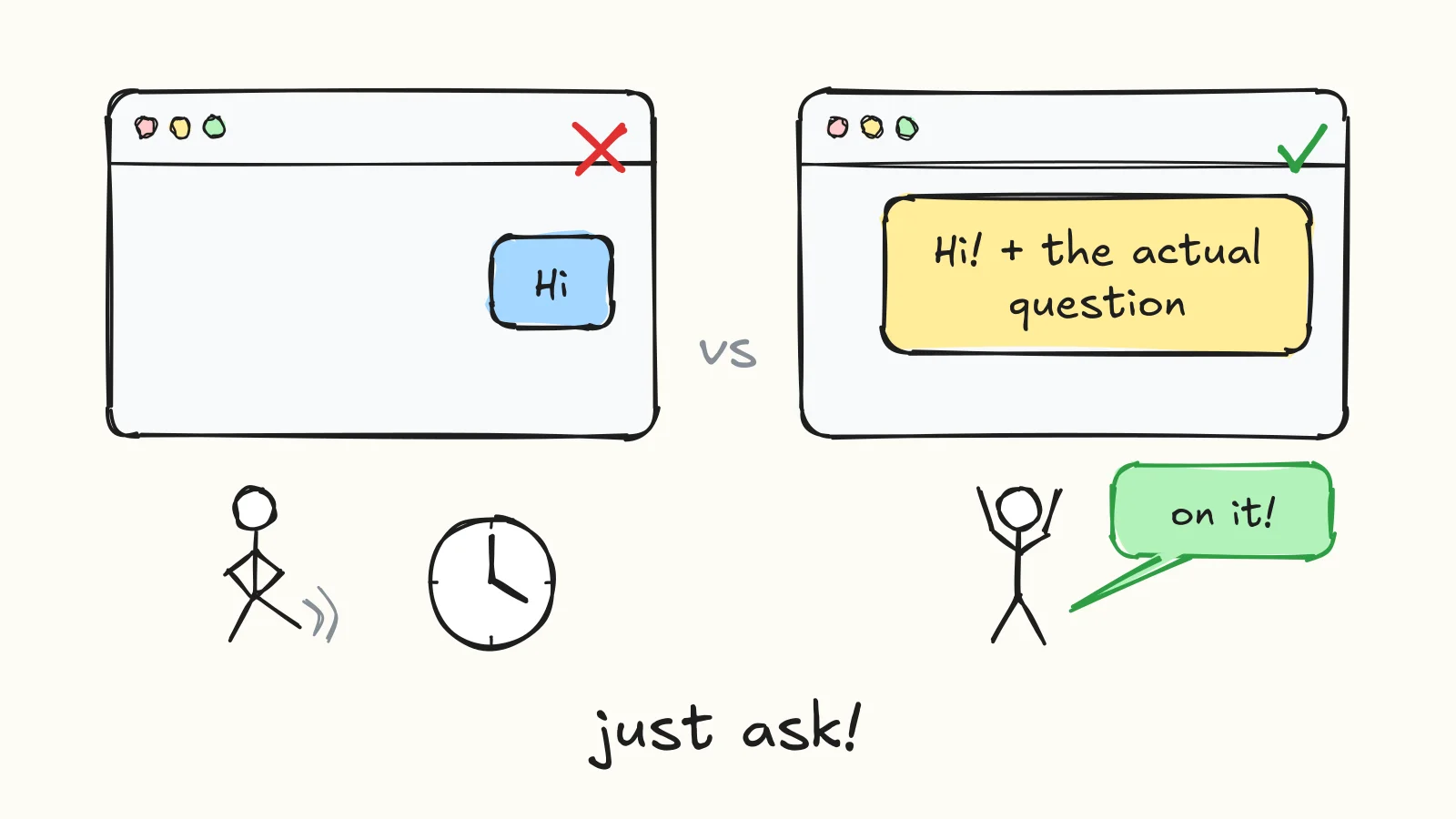
Rather than just sending greetings or “hello” and then waiting for reply, also enrich your messages with the specific question or problem statement. This saves time and fosters asynchronous communication!
When initiating calls, provide context and a time estimate to respect others’ schedules.
Early in my career at Adobe, I received a piece of advice from my tech lead that profoundly changed the way I approach communication at work. They emphasized the importance of asking direct, well-formulated questions that not only demonstrates clarity of thought but also respects the time of your colleagues. This has become [really] [popular] in [last] [decade], but has been the rule of thumb since the IRC days! Pepperidge Farm remembers.
This lesson has stayed with me throughout my career, and recently I shared the same with our team when I noticed a lot of back and forth over our team’s help-channel queries just to gain context, wasting a lot of dev time which prompted me to write this post.
💬 Rethinking Chat Etiquette
Traditionally, conversations often start with a greeting or a check-in. However, in a chat setting, this approach can be counterproductive. A simple “hello” can lead to unnecessary delays as the recipient waits for the actual query or context before actually responding.
Consider this common scenario:
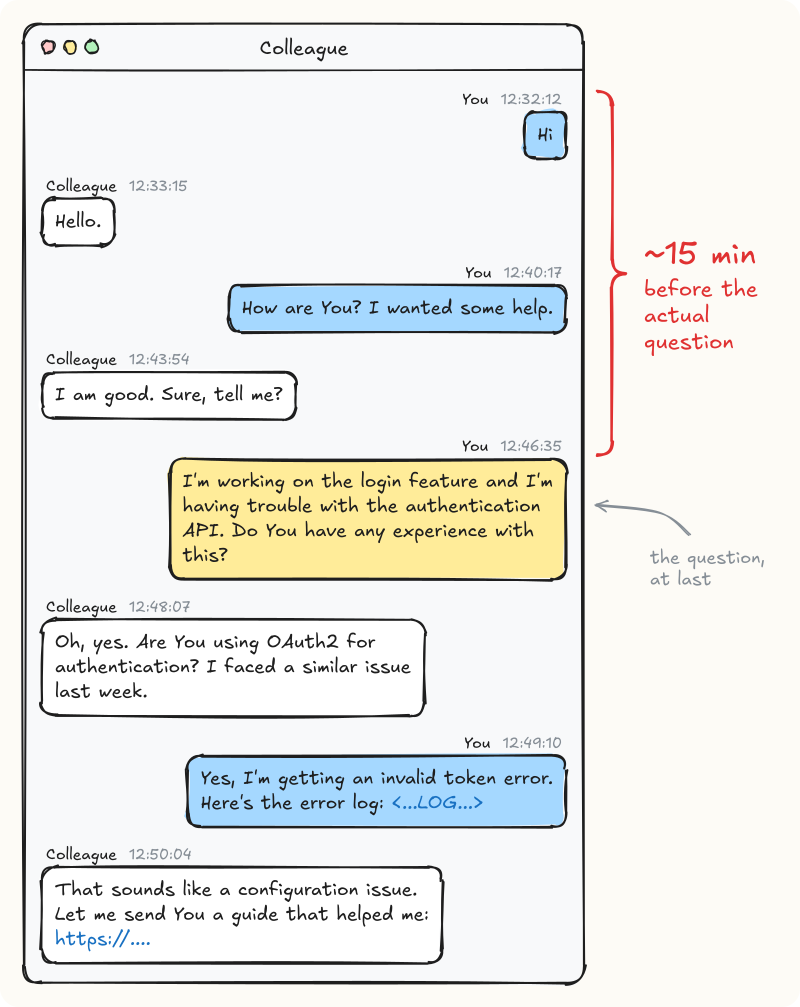
In this example, your colleague has to wait for almost ~15 minutes before understanding the actual query and help you. This waiting period results in lost productivity and delayed response!
Let’s look at another example:
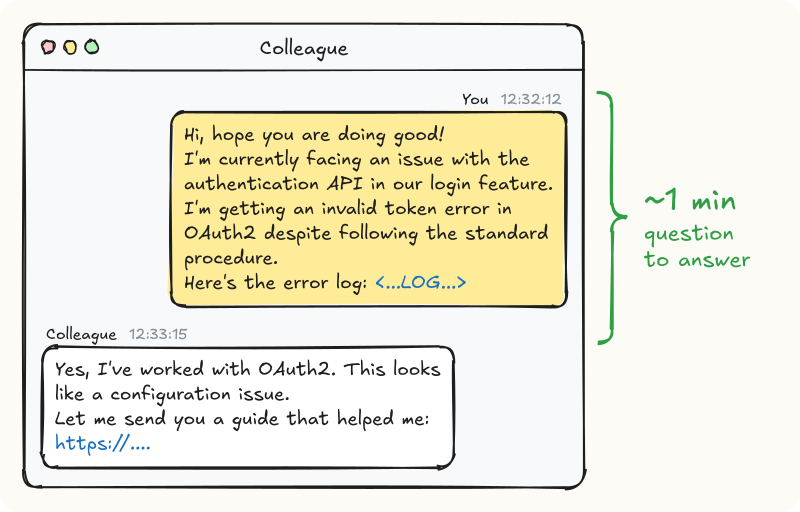
In this efficient example, the query is clear from the beginning, leading to a quicker and more focused response. This approach is more respectful of your colleague’s time as they can immediately engage with the problem, providing helpful feedback within a minute.
Note: One of the advantages of Slack / Confluence is its inherently asynchronous nature. By posing your question directly, you allow the recipient to respond at their convenience, which is crucial especially in a global team like ours where members might be in different time zones.
This approach ensures that even if you’re not online simultaneously, your query has been clearly communicated and can be addressed as soon as the recipient is available.
⁉️ Don’t ‘Ask to Ask’
In many channels I have observed that people tend to preface their questions with queries like:
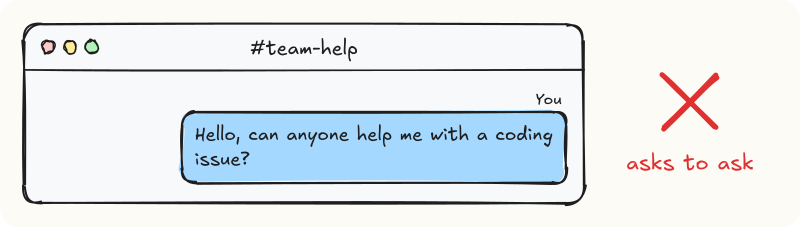
⚠️ Especially, never pair ⬆️ with
@hereor@channelto ping everyone under the sun! Try to use the approach suggested in the channel’s topic instead, like the team’s support or on-call handle.
This not only wastes time but also potentially discourages peers who could have potentially answered from engaging. Instead of asking a generic query, you can directly present your query like:
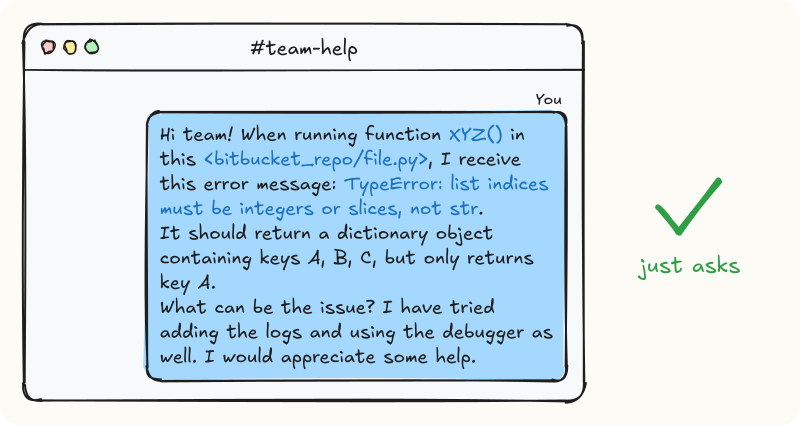
As we can observe here we:
- Clearly outlined the problem: Shared relevant details (error messages, expectations vs reality) and avoided ambiguity.
- Isolated the problem: When possible, minimize the scope of the issue being addressed to ease comprehension and troubleshooting efforts.
- Limited jargon and abbreviations: Ensure your language remains accessible to everyone involved.
- Performed research prior to asking: Utilize search engines, manuals, tutorials, and other tools before requesting help. Document attempts made towards resolving the issue based on findings.
📞 Calls: Setting Expectations
The same principle applies to calls. Instead of an abrupt call or a message like:
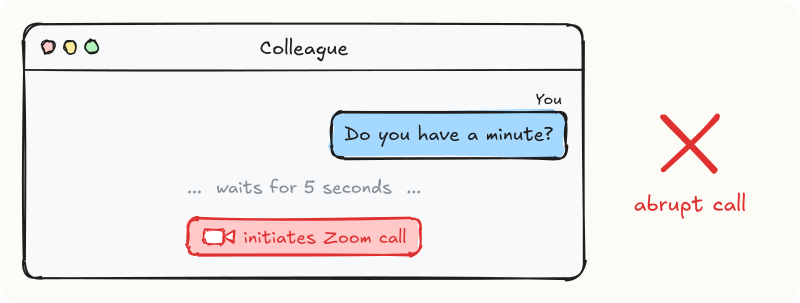
A more considerate approach can be to provide context and a clear agenda. For example:
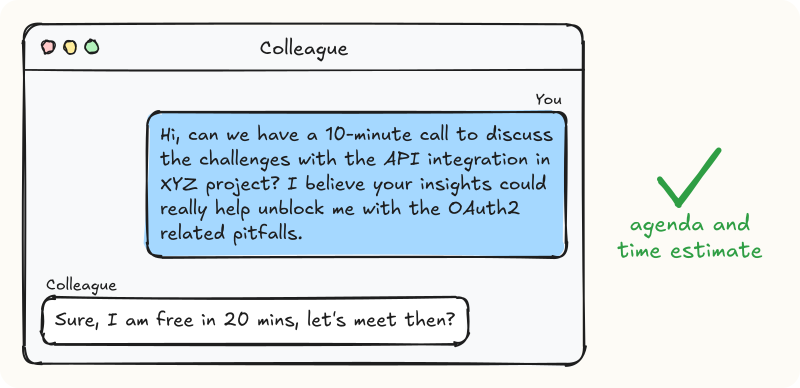
This approach shows respect for your colleague’s schedule and allows them to prepare for the discussion, making the call more productive! A win-win if you ask me!
In case you want to explore this further, here are some of the interesting related reads:
- https://dontasktoask.com/
- https://www.mikeash.com/getting_answers.html#guide_begin
- https://josh.works/better-questions
- https://stackoverflow.com/help/minimal-reproducible-example
- https://nohello.net/en/
Update, November 2026: I folded this into a bigger talk for the new joiners on my team, about asking with context, owning the next step and leaving a clearer path for the next person: Lift Each Other Up.
In conclusion, implementing a more straightforward and succinct communication approach in chats and calls can greatly improve productivity and demonstrate respect for one another’s time, particularly in a remote-first asynchronous environment.
Bonus: This also allows you to embody our values at Atlassian effectively:
OPEN COMPANY, NO BULLSHIT We value open and honest communication. By asking direct questions, we uphold this principle, ensuring that our conversations are clear and devoid of unnecessary fluff!
PLAY, AS A TEAM By being direct and to the point in our communication, we not only respect each other’s time but also build a stronger, more collaborative team.
BE THE CHANGE YOU SEEK As we embody the change we seek, let’s lead by example in our everyday interactions, setting a standard for efficient and effective communication.
Fin.
Keep reading
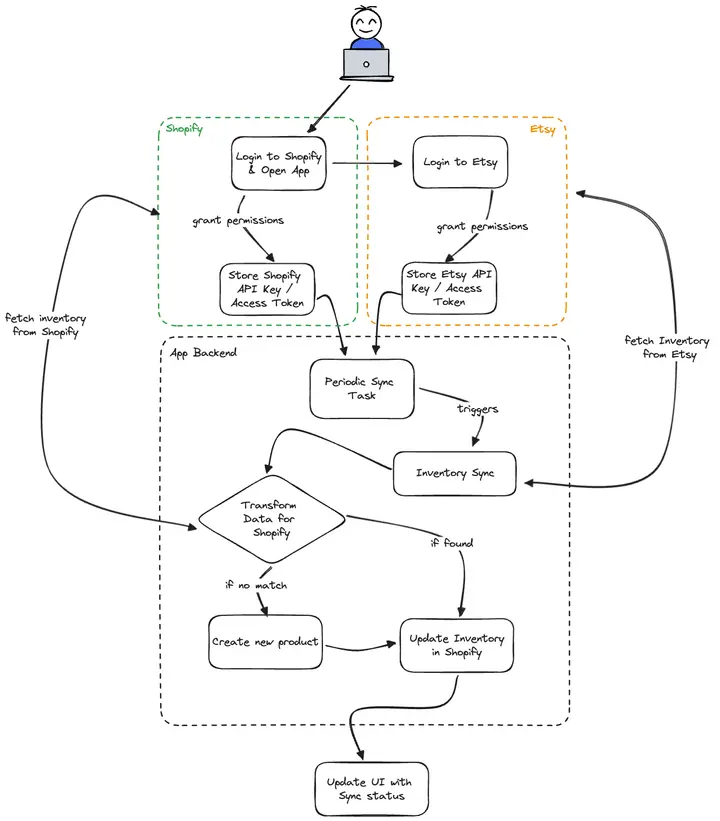
Speccing a Shopify app for a friend: Etsy-to-Shopify inventory sync
A friend needed a Shopify app that keeps stock in sync with Etsy. Before any code, I wrote him a spec to hand to a developer: scope, diagrams and a 70-hour initial estimate.
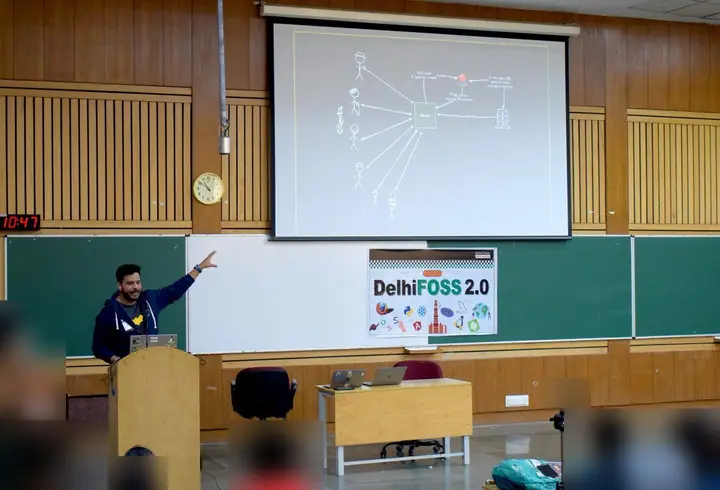
The Redis Paradox: my DelhiFOSS 2.0 talk at IIT Delhi, written up
The written version of my DelhiFOSS 2.0 talk on Redis beyond caching: a short history of caches, live driver matching with GEO commands, and Pub/Sub.

The engineering books I'd read first, and how I actually get through them
A Blind post listed 9 books for a >600K/yr engineering job. I've read 8 of them. Here are the ones I'd read first, and the habits that get me through books.
Comments
No comments yet. Start the conversation.
Comments couldn't load right now.