The Windows Phone apps I'm not proud of: a 3G booster that was just a progress bar
Four of my Windows Phone booster apps passed certification as a progress bar and a random number. Eight more were App Studio apps on other people's brands.

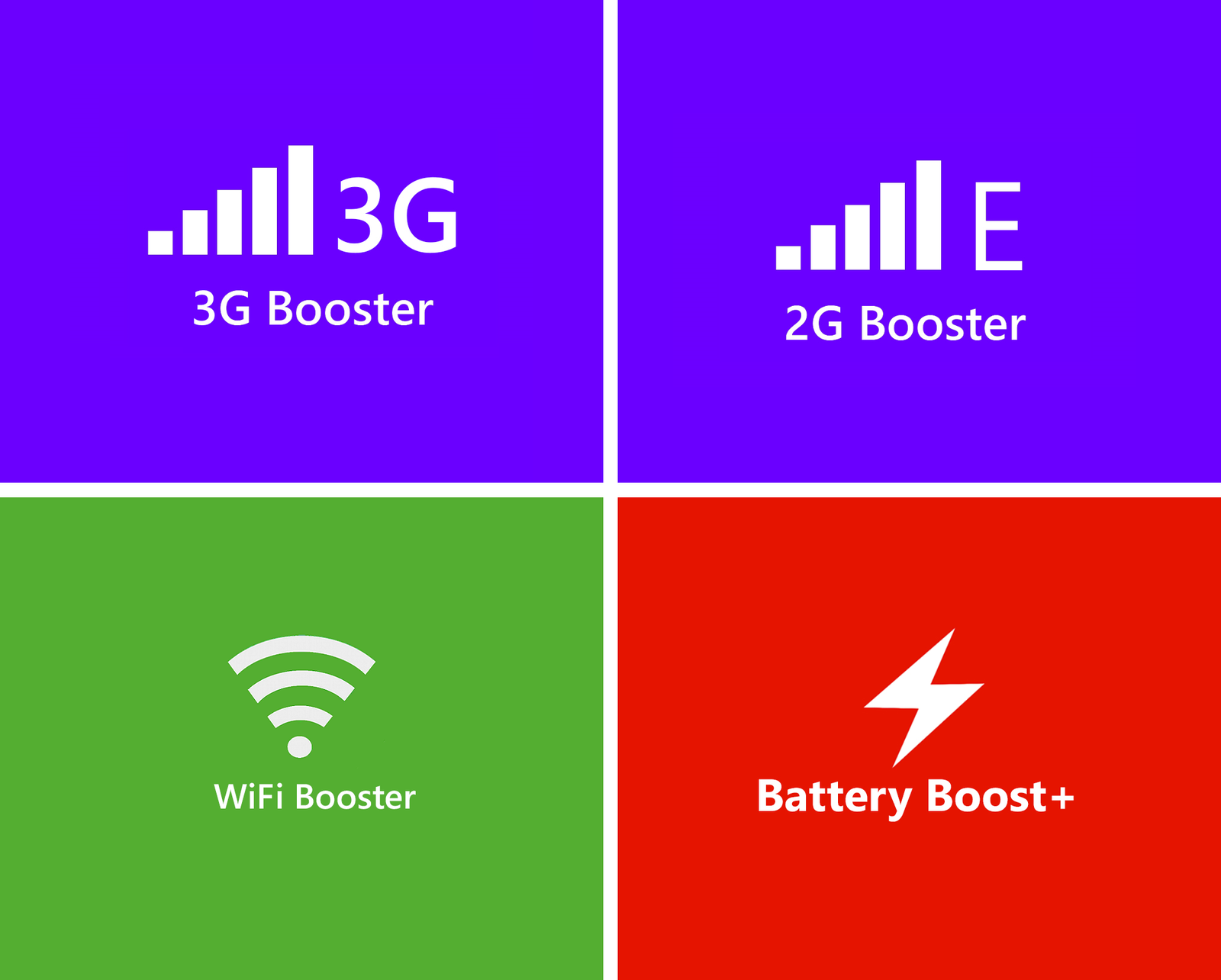
Confession time! Last December, in my final year of engineering, I wrote an app called 3G Booster. On 20 December it passed Windows Phone Store certification. Nine months later, here is the whole “engine”, straight from the last version of its MainPage.xaml.cs I have:
var = r.Next(17,37);
msgs.Add("Initializing...");
msgs.Add("Increasing 3g antenna power...");
msgs.Add("Decreasing antenna resistance...");
msgs.Add("Enabling 3g broadcast reciever...");
msgs.Add("Enabling Multi-Channel Directional Reception...");
msgs.Add("Changing Channel to reduce Interference...");
msgs.Add("Signal Strength boosted by "+var.ToString()+"%");
(Yes, var is an int field. I named a variable var. Don’t ask.)
That’s it. A list of strings, a timer that walks through them, and a random number between 17 and 36 at the end. Random.Next leaves out its upper bound, so I couldn’t even get my FAKE range right :P Nothing in the app touches the antenna, the network or any phone setting. And I made three more just like it.
This post is about those four, and about the apps I built on brands that weren’t mine. One of those got me an infringement complaint in June. Honestly, I’d rather skip this part of my Windows Phone story, but here it is.
One template, four apps
The booster family lived in four Visual Studio projects between 10 December and 20 January. All four still use the namespace _3G_Booster and share one ProductID, because I just copied the folder and changed the strings. And all four passed certification, three of them in the week before Christmas!
| App | Certified | What it “did” | The random number (last build) |
|---|---|---|---|
| 3G Booster | 20 Dec 2013, update 26 Dec | “Increasing 3g antenna power…”, “Decreasing antenna resistance…” | 17 to 36% |
| WiFi Booster Pro | 20 Dec 2013 | “Cleaning DNS Cache…”, “Renewing the DHCP IP address…” | 13 to 27% |
| 2G Net Booster | 23 Dec 2013 | “Directing antenna towards Strongest 2G Signal…”, “Enabling Enhanced Data Rate EDGE…” | 18 to 33% |
| Battery Boost+ | 2 Jan 2014 | “Deactivating Idle Processes…”, “Optimizing CPU voltage…” | 18 to 33% |
In January I sent a v2 of each. Battery Boost+ v2 passed on 22 January and WiFi Booster v2 on the 23rd. Same day, the 2G and 3G v2s came back as failed.
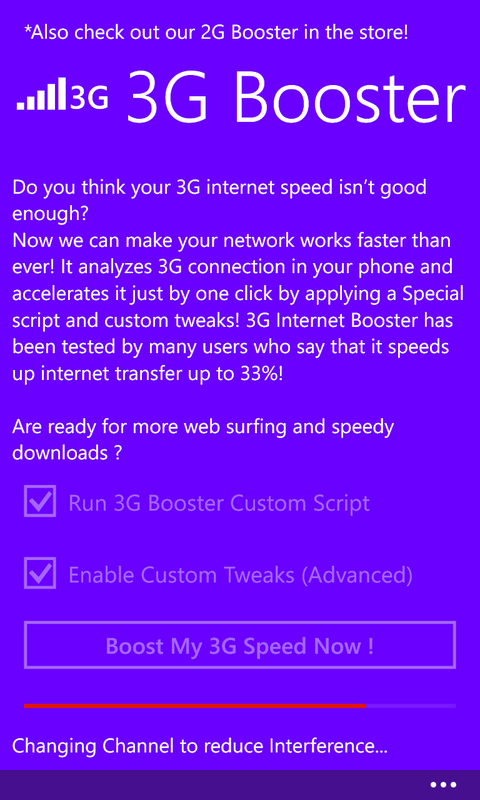 3G Booster, the January build, a few seconds into a “boost”.
All four work exactly the same way:
- You tick a checkbox like “Run 3G Booster Custom Script” or “Run Battery Boost+ Algorithm”, which enables the big button.
- “Boost My 3G Speed Now !” starts a
DispatcherTimerthat fills aProgressBarfrom 0 to 200 in steps of 0.5, swapping the status text as it goes. - The last line says your signal was boosted (or your battery life extended) by the random number.
- A message box tells you to come back. In three of them it says “Repeat every 3 days for Best Performance !”. In the January build of 3G Booster, the v2 that didn’t get through, I had changed that to “Repeat whenever you need a Quick Boost! Pin to Start for easy access!”, which is somehow even worse.
The second checkbox does even less. In 3G Booster it’s called lol in the XAML (fitting, right?), and all it does is pop a warning: “Experimental Feature.. / Dont use if you are on 2G Network / Tap More apps for 2G Net Booster!” So the one “advanced” option is basically an ad for the next booster. Each booster plugs another one (“*Also check out our 2G Booster in the store!”, “Do check out our WiFi Booster from more apps”), and the share button in Battery Boost+ still calls it “3G Internet Speed Booster”. Because copy-paste.
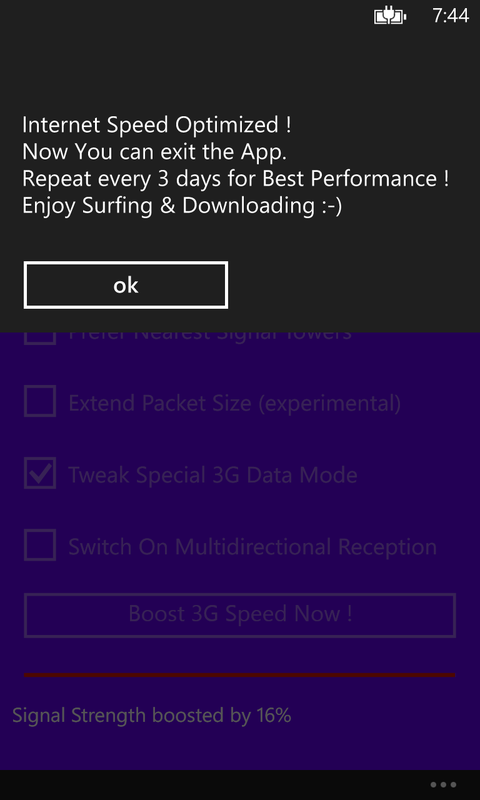
That screenshot is from an earlier build with even more checkboxes (“Prefer Nearest Signal Towers”, “Tweak Special 3G Data Mode”, “Switch On Multidirectional Reception”). It says 16%, a number the January build can’t even roll. Same progress bar underneath.
The numbers don’t even agree with each other. The Store description in the 3G Booster manifest promises “speeds to go up by more than 80 to 90 percent”. The text inside the app says users found it “speeds up internet transfer up to 33%”. The code hands out 17 to 36. And Battery Boost+ never got a description of its own: its manifest still has the 2G Booster text, word for word.
Oh, and of course there’s a rating prompt. RateMyApp pops up on the third launch of 3G Booster with the title “Loving your Increased 3G Speed?” and a “Rate 5 stars” button. Yup.
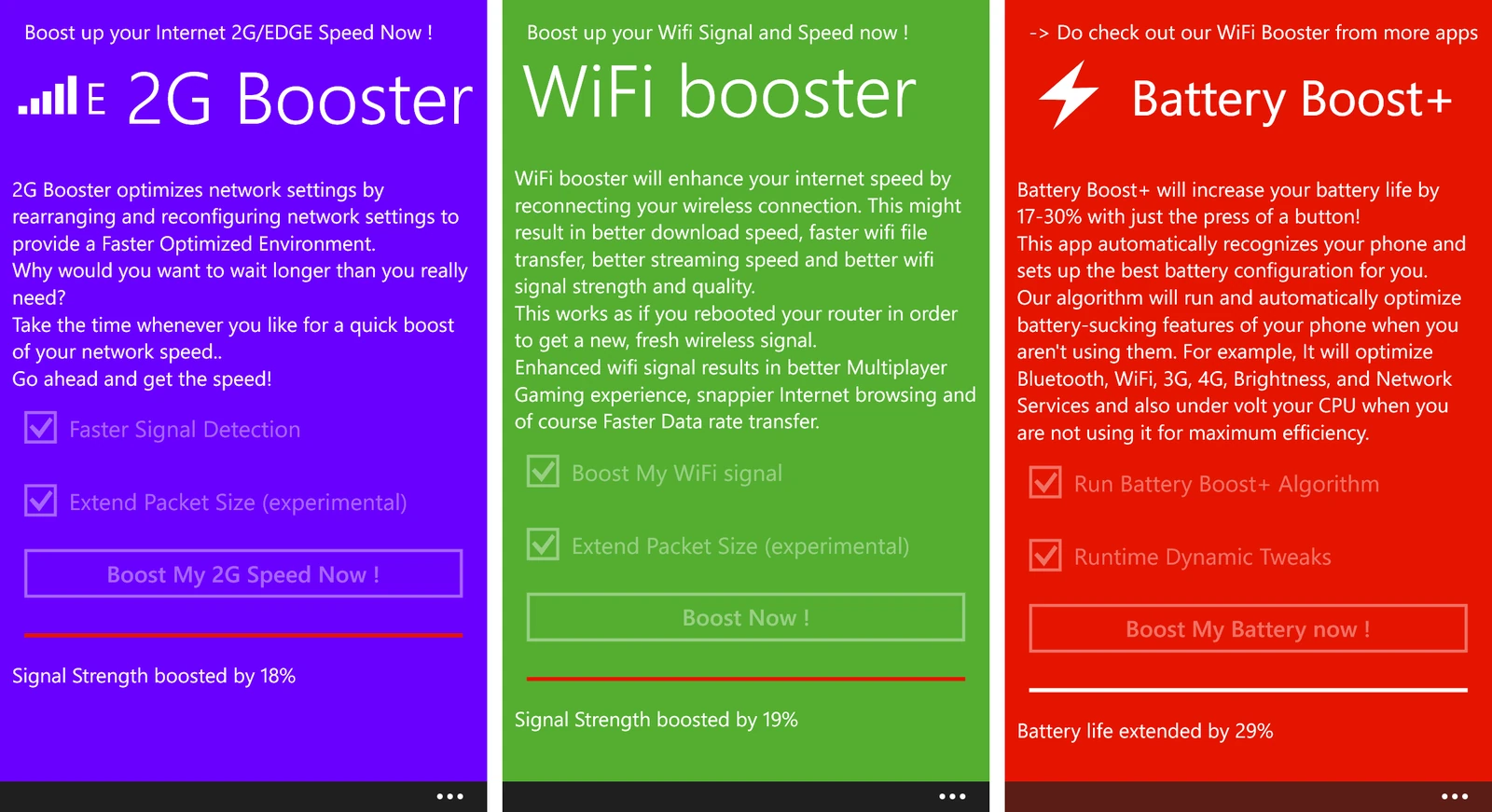 2G Booster, WiFi Booster and Battery Boost+: same layout, different strings, a different random number.
Why I built them
Two reasons. The Store was full of booster apps and they were getting installs, so I wanted some of those. And I needed apps to clear DVLUP challenges and earn XP.
DVLUP, Nokia’s developer rewards programme (I wrote about it and the Lumias in part 1), hands out XP for challenges, and a lot of those challenges are about ratings: “Go ahead, rate my app!”, and a ladder of “4 Stars with 25 Reviews” that goes all the way up to 2,500. Between last October and February I got 20 mails from DVLUP saying one of my entries “did not meet the Challenge requirements”. On 28 December I tweeted that I had “used adduplex campaign, got 89 rev today, but dvlup wont let me refresh bfr 24h”. The same day I tweeted “I m yet to get my #Wp8 smartphone”. So yeah, when three of the boosters went through certification, the guy promising to tune your antenna didn’t even own a Windows Phone 8 phone himself!
Installs or XP, I knew what I was doing. You don’t write Random.Next by accident.
There’s also a sibling from the same Christmas week: a Love Calculator whose entire logic is rnd.Next(70, 100). Nobody scores below 70 :P At least nobody expects a love calculator to be accurate.
Apps on other people’s brands
The other thing I’m not proud of started a month before the boosters. In August 2013 Microsoft launched Windows Phone App Studio in beta. It’s a web tool that builds an app from templates, feeds and pages, and then lets you download the source and keep working on it in Visual Studio. From mid-November I went through it like a vending machine. Here’s what got through certification:
- The Walking Dead, 19 November 2013
- BBC Sherlock, 20 November
- Google Glass, 26 November (it failed on the 21st first)
- PhoneBuff, 27 November
- Vevo, 30 November
- Iron Maiden, 13 December (failed on the 5th)
- India Today, 19 December
- Prison Break, built the same week as PhoneBuff, went through with a batch of updates on 27 December
That’s eight apps through certification in about five weeks, and not one of those names is mine. There was also one called The Big Bang Theory, which DVLUP turned down as a challenge entry.
They’re all wrappers: YouTube channel feeds, RSS, a few XML pages of story and characters, some wallpapers. Vevo kept growing, from about 15 artist channels to 34 sections by version 3.0 in February. Between November and February it went through certification nine times and failed five of them. All of these went up under my publisher name, Jaykay.
The Store listings are the cringiest part, because I wrote them. The Prison Break description is a long encyclopedia-style history of the show. PhoneBuff’s is the PhoneBuff channel’s own about text. The Vevo listing offers “VEVO’s entire catalog of 75,000 music videos” from an app with 34 sections, and ends with a disclaimer saying the videos are hosted on YouTube and to report any copyright issue to us. And Iron Maiden’s opens with “Do you Love Death Metal ?” and calls them “the same old el-classico Death Metal band”. Iron Maiden is NOT a death metal band. Sorry, metalheads.
There’s also a problem I didn’t notice when I made them. Every app App Studio generated for me declares the same nine capabilities (a couple add media ones on top), whether it needs them or not. My Google Glass app, which is just a list of YouTube videos, asks for location, user identity, maps, the phone dialer, proximity, sensors and speech recognition. One reviewer called that out in January: it’s just videos, so why does it want my location and identity? Fair point. The very first review on that app was shorter: “Pretty useless app so far.”
The uncomfortable bit is that some people actually like them. The Walking Dead and BBC Sherlock were still getting fan reviews in August, though one Sherlock review from August just says “Only because of the show”. Still, that doesn’t make them mine to publish.
The email
On 10 June Microsoft forwarded me a Windows Phone Store content-infringement complaint about my app titled “Google Glass”, with instructions to unpublish or modify it through Dev Center.
Four days before that, the listing was still up with three reviews, the latest of them just “Adds only”. By early July the same page said “This app is no longer published”, because I had unpublished it myself after the email.
Then on 27 August Microsoft posted that it is cracking down on misleading apps. New certification rules on app names, categories and icons apply to both the Windows and Windows Phone Store, and its review of the Windows Store has already removed more than 1,500 apps. An app called “BBC Sherlock” from a final-year student with no connection to the BBC is pretty much exactly what those rules were written for. As I write this, BBC Sherlock and The Walking Dead are both still up.
What I’d tell the November 2013 me
- Don’t ship placebo software. If the honest description of your app is “a progress bar and a random number”, you don’t have an app. Anyone who tapped that button was probably on a slow connection and hoping it would help.
- A brand you don’t own isn’t a shortcut. App Studio made it easy to make something called “Vevo”, but that didn’t make it mine. The infringement email was the polite version of what could happen.
- Ask for the permissions you need and nothing else. A video list doesn’t need the phone dialer! Templates are fine, but read what they declare.
- The honest apps do better anyway. In April my Win 8.1 HD Wallpaper app had 2,283 ratings in the India Store. Vevo, the best of the brand apps, had 39.
Did you ever install one of those “booster” apps? Or ship one? Tell me in the comments, I won’t judge. I can’t really :P
This is part 2 of my Windows Phone years. Part 1 is DVLUP, the Nokia events and the Lumias.
Keep reading
Win 10 HD Wallpapers [WP App]
Who doesn't love wallpapers? Try Win 10 HD Wallpapers for Windows Phone to grab the best of tailormade 250+ HD Wallpapers with 1.5mn downloads & 4k reviews!
Three dead Flipkart vouchers, nearly 40 emails and a DVLUP refund
In August I spent 3,000 DVLUP points on three Rs 1,000 Flipkart gift cards. None of them worked. Five and a half months later I got my points back.
Everything I learnt outside class at GGSIPU
Four years of B.Tech CSE at GGSIPU: 9% attendance, a 2,800-fan Facebook page, Baja, DRDO, a one-night call-centre job and 70-480 in 18 minutes.
Leave a comment