The Haswell box: the PC I built in 2015, four years on
The PC I built in 2015: an i5-4440 on a Gigabyte B85M, a GTX 960 a year later, a desk I drew in MS Paint, 16 GB for Chrome, and the dead hard drive that taught me 3-2-1.

Hey folks,
If you’ve been around BitSnapper for a while, you know I’ve written a few “Build your own PC” guides, and in January 2018 I did the big one, with parts lists for every budget from a Ryzen 3 all the way up to a Threadripper. There’s exactly one line about me in it:
In my last 15 years of exposure to computers, I have never bought an OEM (pre-assembled) PC.
What I never showed you was the PC I was using while I wrote it. So here it is, almost two years late lol. Windows knows it as THE-ONE.
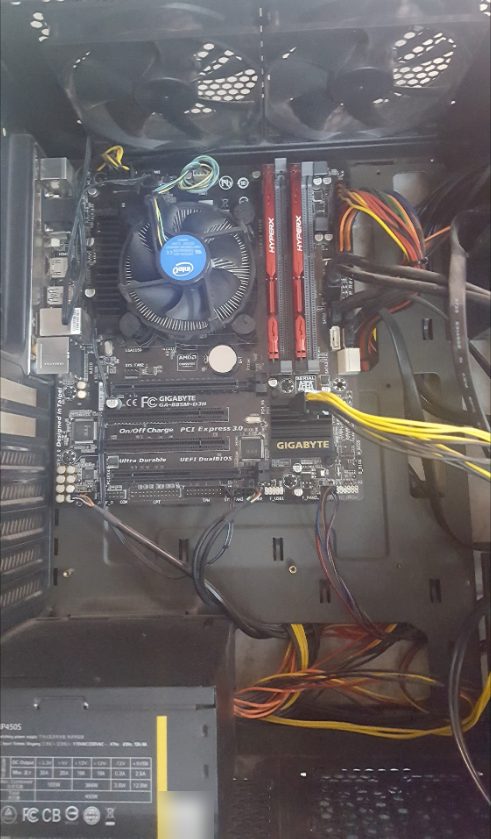
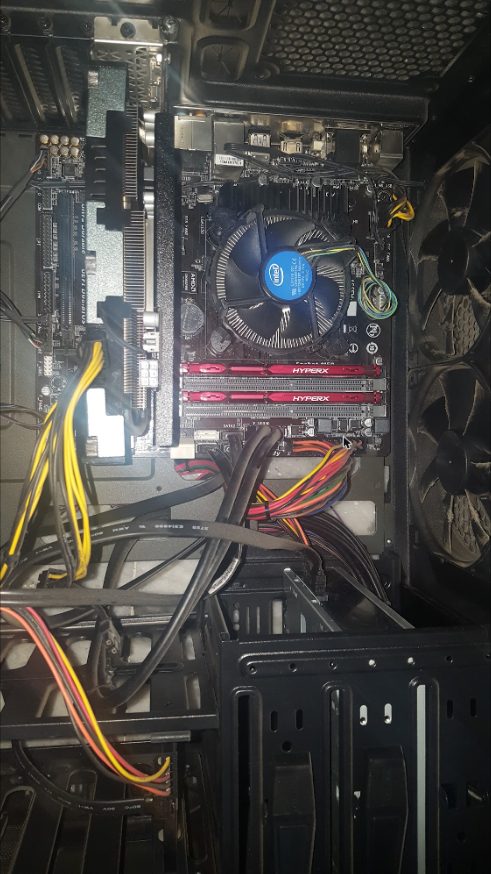 THE-ONE with the side panel off, April 2016.
The parts
I built it in 2015 and bought everything over the counter at Nehru Place in Delhi (where else?). I don’t remember the bill very well any more, but I think the whole thing cost me around ₹65,000 back then.
- CPU: Intel Core i5-4440, a 4th gen Haswell chip. 4 cores, 4 threads, 3.1 GHz base and 3.3 GHz turbo, 6 MB cache, 84 W TDP, LGA1150.
- Cooler: The Intel stock cooler that came in the box. Yep, still the same one.
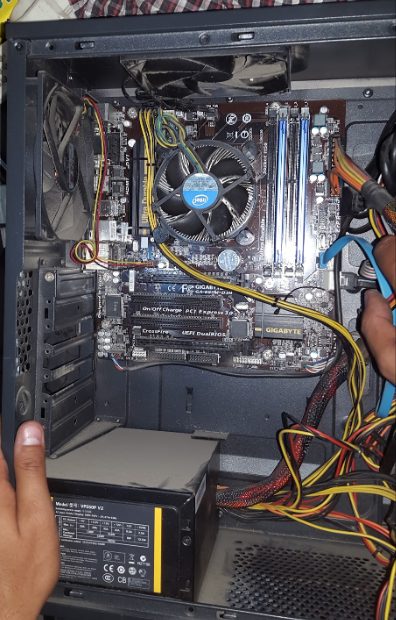
- Motherboard: Gigabyte GA-B85M-D3H, a Socket 1150 micro-ATX board with “Ultra Durable” and “UEFI DualBIOS” printed right on it, and four DIMM slots.
- RAM: Two red HyperX 4 GB sticks, so 8 GB, until this October (more on that below).
- PSU: Antec BP450S, 450 W.
- Graphics: Intel HD Graphics 4600 on the chip, and from April 2016 an Inno3D GTX 960 with 2 GB.
- Storage: Two hard drives.
- OS: Windows 10.
A desk, designed in MS Paint
On 23 January 2016 I sat down and designed a computer table. In MS Paint. Like you do.
Version 1 had a stack of three drawers on the left, a small shelf for the modem above a compartment for the woofer, and a separate bay on the right for the tower (“CPU”, as we all call it, don’t judge). Version 2 dropped the drawer stack and got proper dimensions: a 36” desk plus a 12” bay for the cabinet, 24” deep and 30” high, with one drawer under the desk and another under the CPU bay.
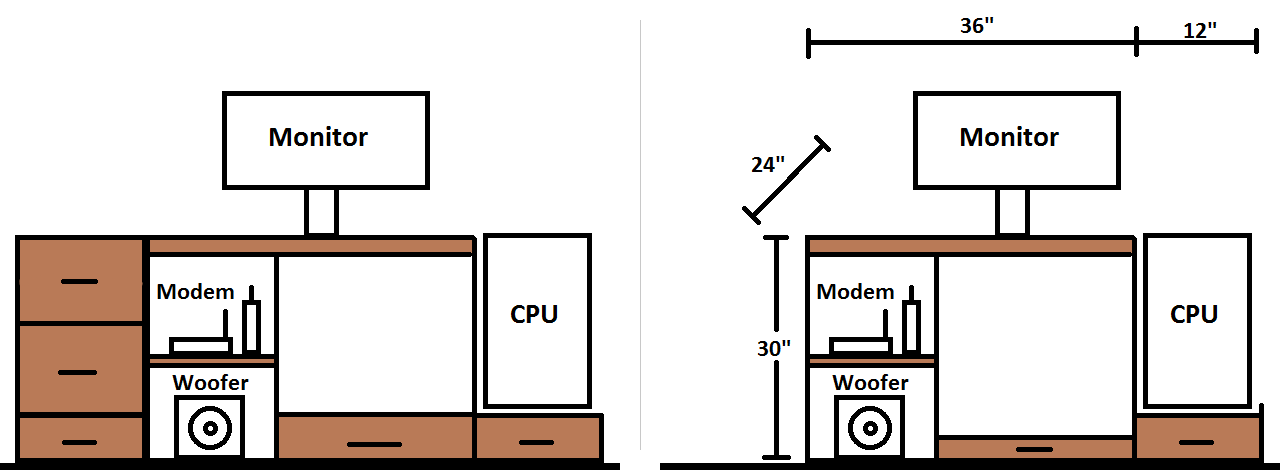 Version 1 on the left, version 2 with the dimensions on the right.
And yes, I actually got it made. :D
February 2016: Rivals on a gamepad
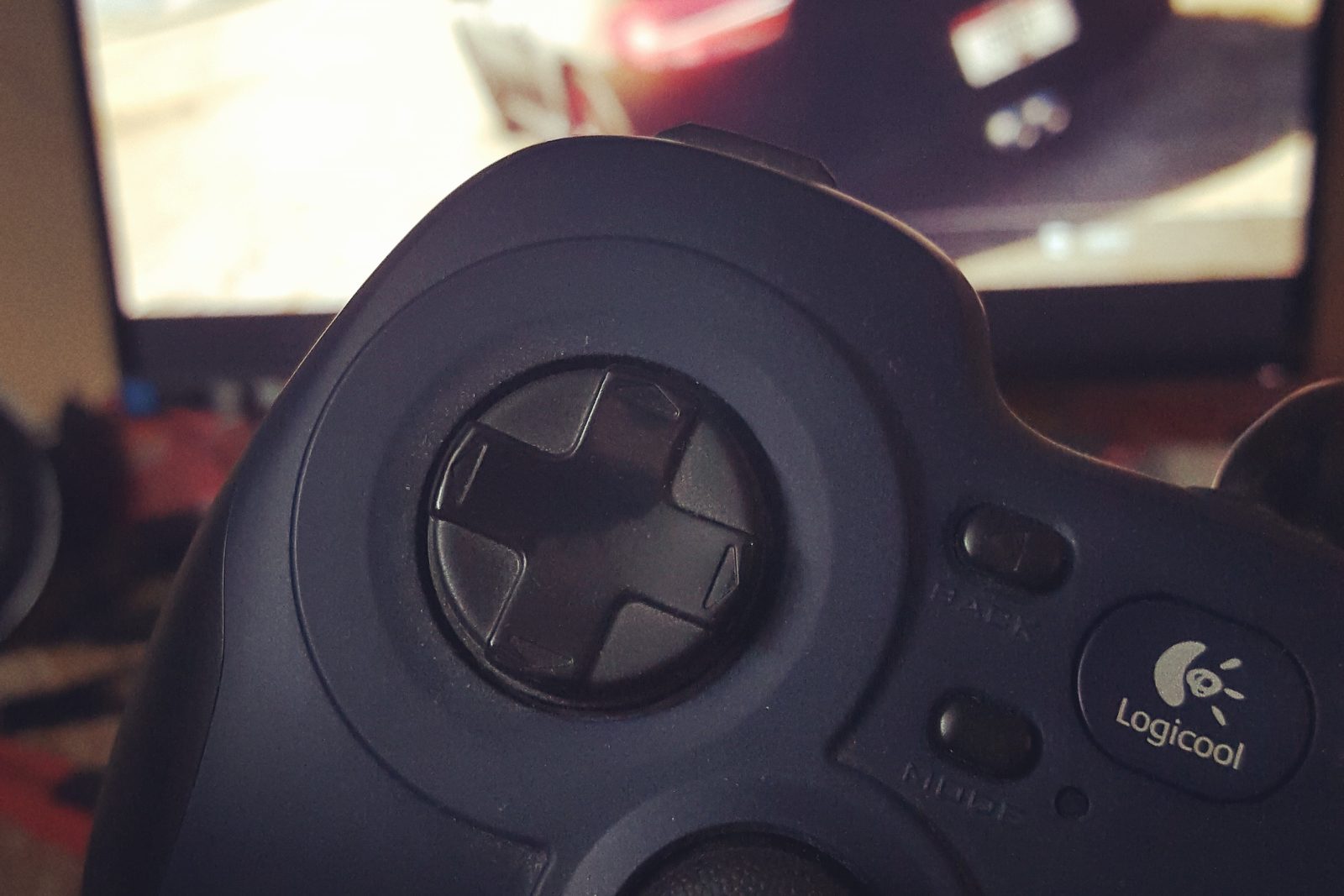
A month later I was racing on it! On 22 February 2016 I posted on Facebook, “Time to burn some virtual rubber off the Asphalt”, tagged #needforspeed #rivals #pcgaming #logitech #gamepad. That was Need for Speed Rivals with a Logitech gamepad, on the integrated graphics, about six weeks before the graphics card went in.
April 2016: the GTX 960
In April 2016 I added an Inno3D GTX 960 with 2 GB. Why that one? It was a decent card from NVIDIA’s new series, and it was in my budget, at around ₹15,000.
NVIDIA launched the GTX 960 in January 2015 at $199 with 2 GB of memory, so a proper mid-range card, and in this box it runs happily off the 450 W Antec.
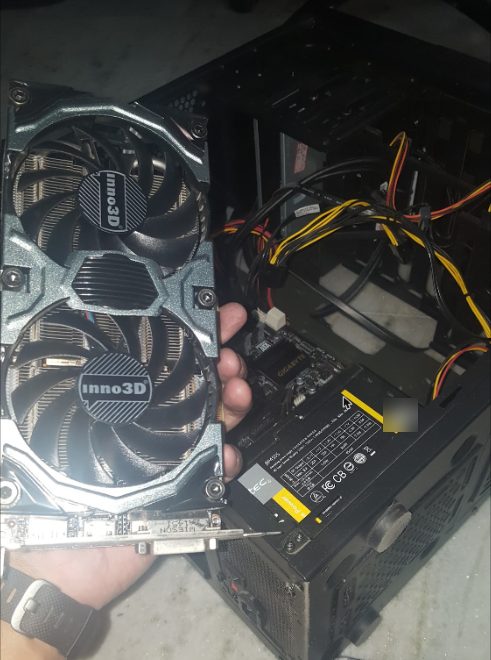 6 April 2016, the Inno3D card just before it went in.
What it runs
My Documents folder on this machine is basically a game shelf: saves for Rocket League from 2016 to 2019, FIFA 18 and FIFA 19, Need for Speed Payback, Dishonored and Telltale’s The Walking Dead. The desktop has a Watch Dogs 2 shortcut sitting next to the Epic Games launcher and OBS.
Two benchmark runs left actual numbers behind.
Rise of the Tomb Raider, 2018. The built-in benchmark at 1920x1080, 60 Hz, VSync on, DirectX 11:
| Scene | Avg FPS | Min | Max |
|---|---|---|---|
| Spine of the Mountain | 55.6 | 8.9 | 131.7 |
| Prophet’s Tomb | 50.1 | 10.5 | 80.2 |
| Geothermal Valley | 58.0 | 29.9 | 70.2 |
Don’t read too much into the Geothermal Valley number though. It’s only 173 frames, so about three seconds, because that run got cut short. Call it 50 to 56 fps on a 2 GB card at 1080p. Not bad at all!
GTA IV, 18 August 2019. An 11 year old game by now. 63.51 fps average over 37.24 seconds at 1920x1080, with High textures and Very High shadows, reflections, water and night shadows. CPU at 63%, system memory at 55%, video memory at 44%. The “Hardware” section of the result file is just a column of question marks, so the game had no clue what it was running on. ¯\_(ツ)_/¯
And it’s not just games. This September I had an Ubuntu shell open on WSL, jatin@The-One, trying out two terminal IRC clients: irssi wasn’t installed, and sudo apt install bitchx came back with “Unable to locate package”. Pfft.
October 2019: 16 GB, because Chrome
This October I finally went from 8 GB to 16 GB of RAM. The reason is not exciting: running Chrome had become difficult on 8 GB. That’s it. That’s the upgrade story.
Around the same time I also ran a quick temperature check on the stock cooler:
- Idle: 5% CPU at 3.27 GHz, cores at 42 to 45 °C.
- Load: 92% CPU at 3.09 GHz, cores at 62 to 64 °C, 65 °C max. Core Temp had the package drawing only 20.6 W, so okay, not exactly a torture test.
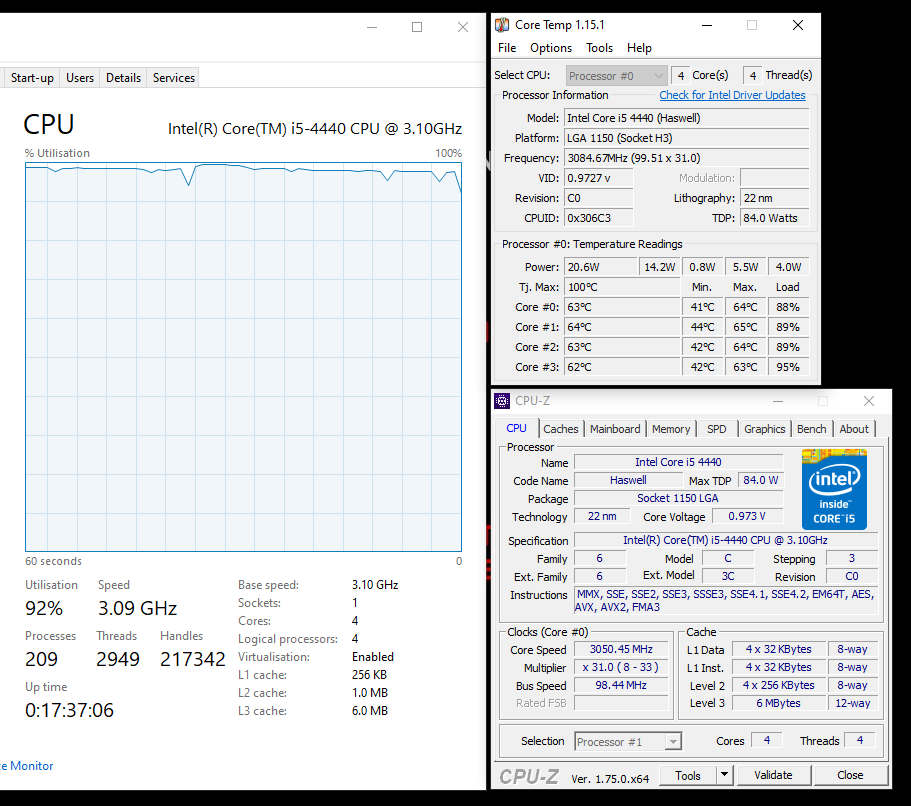 Under load, 10 October 2019.
November 2019: the drive that died
And then last week the side panel came off once more, for a much worse reason. One of the hard drives broke.
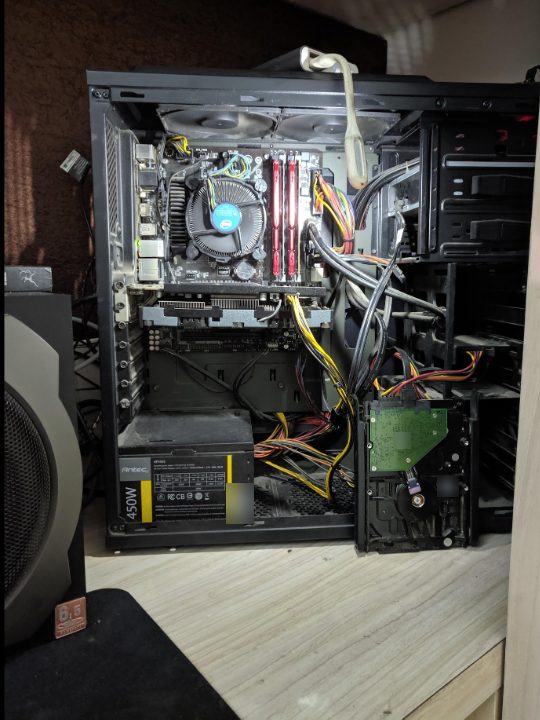 23 November 2019, the dead drive out of its bay.
I gave it to a data recovery facility to get my data back, but the drive was too far gone.
That’s how I learned the 3-2-1 backup rule, the hard way: three copies of your data, on two different kinds of storage, with one of them somewhere else. I’ve become a bit obsessed with NAS storage since. :P
If you’re building your first PC
Here’s what this box has taught me so far:
- The stock cooler is fine for a locked chip, at least for what I throw at it. Intel’s box cooler keeps the i5-4440 in the low to mid 40s at idle and at 65 °C or below on that load test.
- A mid-range card goes a long way at 1080p. The GTX 960 launched as a $199 card, and in 2018 it still averaged 50 to 56 fps in Rise of the Tomb Raider.
- Back up before the drive dies, not after. One drive is zero backups.
The first PC in our house was a Pentium 100 back in 1996, a family machine. The first one that was actually mine was a Pentium 4 from my school days, and it got its own post back in 2015 when I put LXLE Linux on it.
What was the first PC you built yourself? Tell me in the comments!
Keep reading
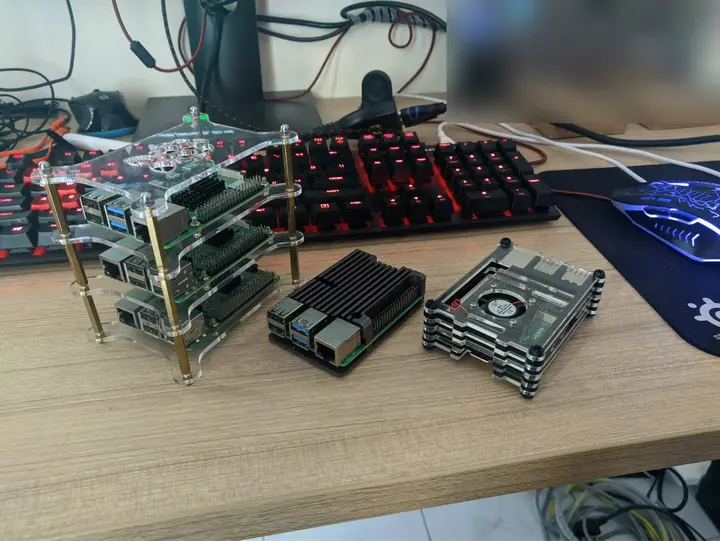
Zion, part 0: my homelabs before it, from a Pi stack to a Dell R510
Before Zion there was a Raspberry Pi stack in Bangalore and a Dell PowerEdge R510 in Delhi. What they ran, what I sold, and what made it to the US.

Build your own PC - Killer rigs for any budget | 2018 | India
Are you a PC enthusiast or a Hardcore Gamer? Join the fun to hand-pick the best suitable components for your most killer rig of the season. #PCMasterRace
Turning a Samsung Foldable into a Retro Handheld: An AI-Agent-Run ES-DE Setup Guide
20 systems, one frontend, every one running at full speed. Here’s how an AI agent and I got there, including the parts that broke.
Leave a comment